
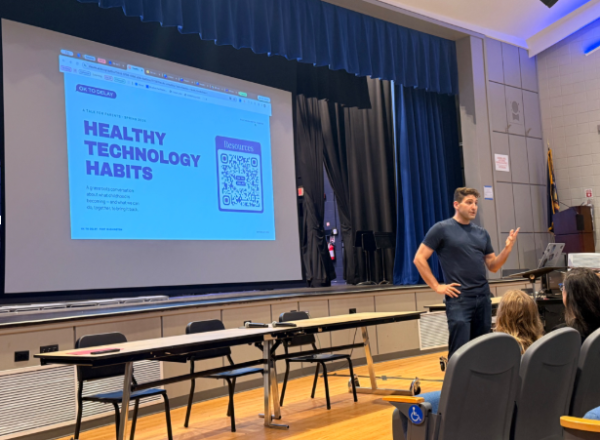
On May 26, the Port Washington Chapter of “OK to Delay” hosted its second annual “Empowering Healthy Tech Habits” night at Sousa Elementary School, where they presented for parents, students, and administrators. “OK to Delay” is a national grassroots movement dedicated to reminding parents that it is okay to normalize phone-free spaces and delay social media and smartphone use for children.
“OK to Delay’s mission relates directly to my experience as an English teacher, as I’ve observed my students’ struggles with being overly dependent on technology both inside and outside of the classroom. Overexposure and overreliance on technology, often due to early exposure, can decrease students’ abilities to think critically, engage in meaningful discussions, and feel confident in themselves,” said Ms. Laura Altieri. “As OK to Delay encourages its audience to consider, delaying students’ use of electronic devices is in the best interest of students, parents, and educators alike.”
Each year, technology plays an increasingly larger role in children’s lives, and some worry that this increase comes with significant long-term consequences. Although many parents agree that the issue should be addressed, individual families struggle to take meaningful action alone, without a community of like-minded others. “OK to Delay” aims to foster a community of families navigating their children’s device usage through discussions, email lists, and other direct measures.
The movement recommends smartphone alternatives like Gabb phones, Pinwheel phones, or Bark phones. These alternatives are simplified cellular devices that provide limitations to internet usage and social media, while still tracking GPS and having call and text capabilities. “OK to Delay” also encourages parents to read, watch, and listen more about technology usage in youth through books like The Anxious Generation and movies such as The Social Dilemma.
At the presentation, speaker and leader of the Port Washington Okay to Delay Chapter Pedro Avila gave an overview of the organization’s recommended solutions to core issues. Avila explained that the nature of childhood has changed in recent decades: parents have become more involved in their children’s lives, phones are handed out increasingly earlier, and children are becoming less independent. Around 2010, both anxiety and time spent on technology among children began to rise, while unstructured outdoor play decreased across age groups, creating a childhood mental health epidemic.
These issues have been discussed in further depth by researchers Lenore Skenazy, Jonathan Haidt, and Peter Gray, all of whom Avila cited in his presentation. He explained that technology is designed to be addictive, and went on to discuss healthier habits to avoid the negative impact of technology, such as picking the right devices at the right times, modeling good habits, and building phone-free spaces.
“Our message is simple: families already struggle with how best to navigate tech with their kids and teens, and technology in schools should be a tool that supports learning without spilling over into home life. We need community organization to ensure that balance is struck thoughtfully,” said Avila.
Avila’s presentation was followed by another presentation by Superintendent of Schools Dr. Gaurav Passi and Assistant Superintendent of Curriculum, Instruction, and Assessment Dr. Sean Feeney. The two spoke about the district’s current policies regarding technology use in schools. Some parents in the audience raised questions regarding technology use among elementary schoolers and requested increased digital citizenship education, while others applauded the administrators for their ongoing efforts to gather and incorporate parental input into school policies.
The night concluded with breakout sessions, which included community discussions with counselors and members of Schreiber’s Compact Committee, conversations about childhood independence, and a meeting dedicated to learning about positive discipline parenting tools.
“Whether it’s regarding AI, digital learning tools, or social media, I truly believe student input is valuable. At the end of the day, we are the ones using the technology as a tool so we are the ones who need to make smart decisions and share our opinions,” said senior Karis Jo, a member of Schreiber’s Compact Committee and an attendee at the event.